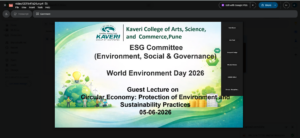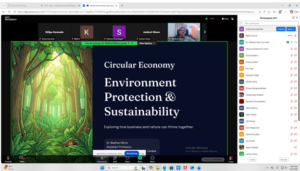

The ESG Committee of the college organized a Guest Lecture on “Circular Economy: Environment Protection and Sustainability” on the occasion of World Environment Day, observed on 5 June 2026. The session was conducted online through the Zoom platform.
The resource person for the session was Dr. Madhavi More, Assistant Professor, CHRIST Deemed to be University, Lavasa. The lecture aimed to create awareness among students about environmental protection, sustainable development, and the importance of adopting circular economy practices in business and everyday life.
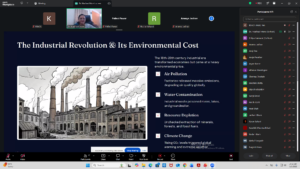
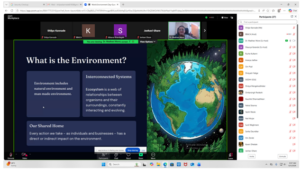
Dr. More began by explaining the concept of the environment, highlighting the interdependence between natural and human-made systems. She discussed how every action undertaken by individuals and organizations impacts the environment. The session further examined the environmental consequences of the Industrial Revolution, including air pollution, water contamination, resource depletion, and climate change. These issues emphasized the need for sustainable approaches to development and resource utilization.
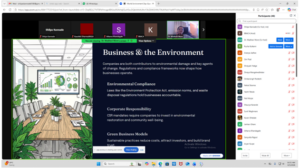
The speaker elaborated on the concept of Sustainable Development, emphasizing the balance among environmental protection, social well-being, and economic growth. She explained the role of businesses in environmental conservation and discussed environmental compliance, corporate responsibility, and green business models that contribute to sustainability.
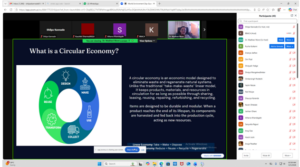
A major focus of the lecture was the Circular Economy, an economic model designed to eliminate waste and regenerate natural systems. Dr. More compared the traditional linear economy model of “Take–Make–Dispose” with the circular economy approach of “Reduce–Reuse–Recycle–Regenerate.” She explained how designing durable products, reusing resources, repairing goods, refurbishing materials, and recycling can significantly reduce environmental impact.
The session also highlighted various strategies that support a circular economy, such as reverse logistics, industrial symbiosis, product-as-a-service models, and eco-design.
To provide practical insights, the speaker presented real-world examples from Indian industries, including Mahindra Group’s vehicle recycling initiative (CERO), Tata Steel’s Industrial By-Product Management Division, and ITC’s efforts in converting farm waste into sustainable packaging materials.
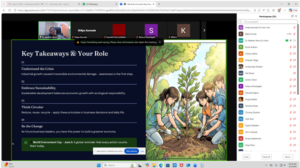
The lecture concluded with key takeaways emphasizing environmental awareness, sustainable living, circular thinking, and the responsibility of future business leaders to contribute to a greener and more sustainable economy. Students actively participated in the session and gained valuable knowledge about environmental conservation and sustainable business practices.
The programme was informative, insightful, and highly relevant in the context of current environmental challenges. It successfully inspired students to adopt responsible consumption habits and contribute towards building a sustainable future. More than 50 students actively participated in the session. Mrs.Chaithra Uchil, Head, ESG committee compared and proposed the vote of thanks for the programme.