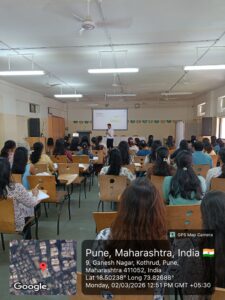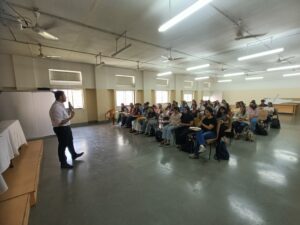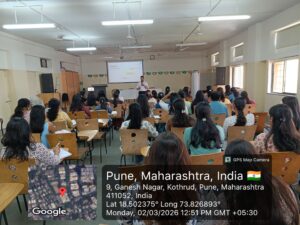
The Psychology Wing under the Department of Arts at Kaveri College of Arts, Science, and Commerce, Pune, organized a Workshop on Trauma Sensitisation on Monday, 2nd March 2026. The session commenced with a formal introduction of the guest speaker and dignitaries by the host and compere, Ms. Arundhati Bindu, SYBA student. She warmly welcomed and introduced the dignitaries: Dr. Muckta Karmarkar, Principal; Dr. Pooja Ambole, I/C Co-ordinator, Arts.
The workshop was conducted to create awareness and sensitise students to the concept of trauma, providing them with an understanding of how trauma impacts an individual’s life, and introducing them to trauma-informed approaches within the field of Psychology. The session was facilitated by the guest speaker, Mr. Abhishek Bhave, Co-Founder, Psychologist, The Secret Ingredient Mental Health, who is currently pursuing a Postgraduate Diploma in Trauma-Focused Therapy.
Mr. Bhave commenced the session by explaining the concept of trauma and distinguishing between single-event trauma and complex trauma. He elaborated on the continuum of trauma and discussed how various mental health disorders, as commonly understood within psychological frameworks, may be understood along this continuum. He introduced the trauma-informed lens, which views certain psychological disorders as adaptive responses to overwhelming experiences. He emphasised the importance of identifying and highlighting salutogenic factors to promote client well-being and resilience.
The speaker further differentiated between “Big T” and “Little t” trauma. Big T trauma refers to events that threaten an individual’s life or bodily integrity, such as war, the loss of a loved one, the loss of a career, witnessing death, major surgery, or life-threatening illness. Such experiences may lead to Post-Traumatic Stress Disorder (PTSD)-like symptoms. In contrast, Little t trauma includes distressing experiences that may evoke trauma responses but do not necessarily result in PTSD symptoms. Examples include legal troubles, divorce, academic pressure, and experiences of infidelity.
Mr. Bhave also discussed the impact of abuse, neglect, and household dysfunction on the development of trauma and subsequent trauma responses. He explained the four survival responses associated with trauma – Fight, Flight, Freeze, and Fawn, collectively referred to as the “4 Fs” of trauma survival.
The concept of the “Window of Tolerance” was then introduced, along with the metaphor of the wave to explain states of hypoarousal, optimal arousal, and hyperarousal. He highlighted how, in the absence of regulation and a sense of safety, individuals may fluctuate between these states, resulting in dysregulation and distress.
Subsequently, a case study was presented, followed by a lively and insightful discussion. Students explored how trauma can manifest in diverse ways and how it may translate into dysfunction and distress across various domains of an individual’s life.
The speaker further elaborated on working with clients experiencing trauma through a phased approach. The first phase focuses on establishing safety and stabilisation, along with teaching self-regulation skills. The second phase involves trauma processing, and the third phase centres on reconnection and resource building.
He also addressed the role of the therapist’s self in trauma work. Emphasis was placed on recognising and managing countertransference during sessions, engaging in co-regulation, identifying and maintaining an appropriate pace of therapy, prioritising relational work, and practising consistent self-care to prevent burnout and maintain therapeutic effectiveness.
This session was conducted as an add-on course for students. The workshop concluded with a vote of thanks delivered by Ms. Priyal Shah, TYBA student. Overall, the session was informative, engaging, and interactive, providing students with valuable insights into trauma sensitisation and trauma-informed practice.