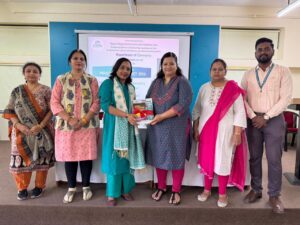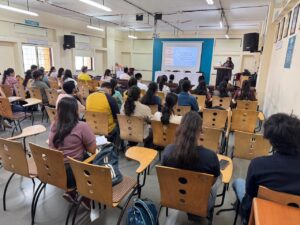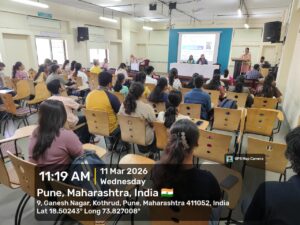

The Department of Commerce organized a highly insightful guest lecture as part of the “Industry Youth Connect 2026” series on 11th March 2026. The session, titled “Scope of Forensic Accounting from a Student’s Perspective,” by CA Neha Phadke, a distinguished expert with over 17 years of experience in Audit and Forensic Accounting. The program aimed to bridge the gap between academic theory and the rapidly evolving field of financial investigation.
The event commenced with a welcome address by Dr. Deepa Sathe, Coordinator of B.Com and M.Com, who emphasized the need for students to identify niche career paths in the commerce domain. Following the welcome, an introduction of CA Neha Phadke, was given by highlighting her significant contributions to the field, including her role in training the Economic Offences Wing (EOW) of the Maharashtra Police and her recognition as the “Young Fraud Investigator of the Year (Female) 2023”. Dr. Muckta Karmarkar, Principal formally felicitated the guest speaker with a token of appreciation.
Key Technical Insights
CA Neha Phadke delivered a comprehensive presentation, moving from the foundational concepts to advanced investigative techniques.
- Understanding Forensic Accounting
- Concept: She defined forensic accounting as the intersection of accounting, auditing, and investigative skills used to provide evidence for legal proceedings.
- Whistle-Blower Awareness: Students were advised to actively research corporate websites to understand Whistle-blower policies, emphasizing that transparency starts with awareness.
- Educational Pathways & Global Certifications
The speaker highlighted specialized avenues for students interested in this career:
- International: The Certified Fraud Examiner (CFE) course from the USA.
- National: The National Forensic Sciences University (NFSU) in Gandhi Nagar, Gujarat—India’s premier and only institute dedicated specifically to forensic studies.
- Core Engagement Areas & Opportunities
She categorized the career opportunities into three primary domains:
- Forensic Accounting Services: Focuses on financial statement manipulations and fund diversions.
- Investigation Services: Digging into asset tracing and anti-money laundering reviews.
- Litigation Support: Providing expert testimony and assistance in legal disputes.
- Regulatory & Investigative Landscape
The session covered how different bodies utilize forensic accounting:
- Management: To assess internal risks and investigate irregularities.
- SEBI: To investigate market manipulation in listed companies.
- NCLT: Focusing on mismanagement and corporate fraud under the IBC.
- Tax Authorities (CBDT/CBIC): For investigating tax evasion and assessing true liabilities.
- Technical Methodology
The speaker introduced critical tests used during audits:
- Test of Reasonableness: Checking if financial data aligns with logical business expectations.
- Test of Impossibility: Identifying transactions that physically or logically could not have occurred.
Rather than a traditional conclusion, CA Neha Phadke provided a roadmap for the future:
- Upskill: Continuously upgrade technical knowledge to match digital fraud evolution.
- Whistle-Blower Advocacy: She urged students to preach a “zero-tolerance” policy for corruption.
- Professional Integrity: Suggested the strict implementation of codes of conduct and complete confidentiality for those reporting frauds.
- Synergy: Encouraged students to capitalize on the overlap between law, technology, and accounting.
The session concluded with an interactive Q&A where students cleared doubts regarding the practical challenges of investigating EOW cases. The formal vote of thanks was proposed, expressing gratitude for organizing this successful industry interaction.