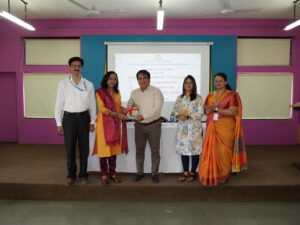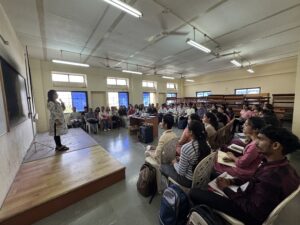

Kaveri College of Arts, Science and Commerce, Pune in association with M.R. Pai Foundation and Forum of Free Enterprise, Mumbai organized Leadership Training Camp on 7th & 8th August 2025. The workshop had an impressive lineup of two speakers, each set to deliver a unique and enriching session. The Workshop began with inaugural session, introduction and felicitation of the Resource Persons Mr. Sachin Kamath and Mrs. Clarissa Jathanna.
In Session 1, Ms. Clarissa Jathanna delivered an insightful talk on “Sharpening Communication Skills.” She began by explaining the concept of leadership and how effective communication forms its foundation. She introduced the “4 P’s of Speaking” – pitch, pace, pause, and power – and explained how mastering these elements can enhance public speaking. Emphasizing that listening and comprehension are essential components of good communication; she guided participants on handling tasks more effectively through clarity in expression. The importance of speaking up to ensure work completion was stressed, along with a live demonstration of formal sitting posture suitable for professional settings. She further spoke about the value of attentive listening, maintaining focus, observing people’s behaviour, and conducting oneself appropriately in varied environments.
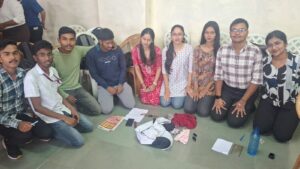
In Session 2 Ms. Jathanna focused on “Decision Making and Problem-Solving Abilities.” The session began with an interactive activity designed to stimulate problem-solving skills. She encouraged students to write down the problems they were currently facing and defined the true meaning of problem-solving. Through group tasks, participants explored collaborative approaches to challenges. She introduced the concept of “clutter” and explained the importance of organizing one’s knowledge and resources to work efficiently. A decision-making activity was carried out to highlight the importance of distributing work within a team, avoiding distractions, and optimizing focus. She concluded by advising students to limit time on social media, suggesting the use of digital wellbeing tools to enhance productivity.
In session 3 was on “Goal Setting & Achieving: A Roadmap to Success” facilitated by Mr. Sachin Kamath. The speaker elaborated on the significance of both short-term and long-term goals and how they guide personal and professional growth. The SMART framework – Specific, Measurable, Achievable, Relevant, and Time-bound – was introduced as an effective goal-setting tool. Participants learned how breaking larger objectives into smaller, manageable milestones could lead to consistent progress. The importance of tracking progress, celebrating small wins, overcoming procrastination, and maintaining self-discipline was emphasized. The session also highlighted how aligning goals with personal values ensures motivation and long-term fulfilment.
In Session 4 by Mr. Sachin Kamath on “Mastering Habits: Unlocking Personal Potential.” He opened with the importance of goal setting as a stepping stone to success and discussed the qualities one needs to cultivate to become highly successful. He stressed that creativity combined with discipline is vital to achieving excellence. Students were guided on how to strengthen their abilities while reducing weaknesses and were encouraged to form positive habits. A self-reflection writing task was assigned to help students better understand their strengths and areas for improvement. Mr. Kamath underlined the importance of consistency and motivated students with the phrase, “Your skills pay your bills,” urging them to acquire market-relevant skills. He concluded by highlighting the need for confidence, self-expression, and focusing on small goals to achieve larger ambitions.
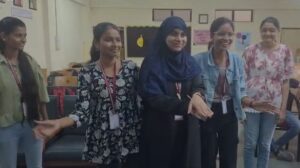
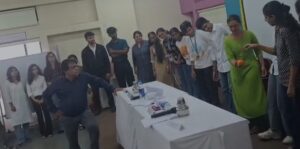
Session 5 also by Mr. Kamath, was centered on “Enhancing Essential Teamwork Skills.” This session was highly interactive, featuring a group activity where students imitated elephants, fish, and peacocks to better understand team dynamics. The activity encouraged cooperation, role awareness, and effective communication within groups, demonstrating how diverse roles contribute to collective success.
Session 6 was on “Believing in Oneself: Building Meaningful Connections” facilitated by Mrs. Jathanna. The speaker discussed how self-confidence forms the foundation for establishing valuable relationships. The role of body language in reflecting self-belief was explained, along with the importance of stepping out of comfort zones to connect with others. Participants were encouraged to practice active listening, show empathy, and focus on trust-building as a gradual process. The session emphasized maintaining authenticity in both personal and professional relationships and networking with a purpose, aiming for quality over quantity.
Overall, the two days of sessions provided participants with valuable lessons in communication, problem-solving, leadership, goal setting, personal development, teamwork, and relationship building. Each speaker delivered practical strategies supported by interactive activities, ensuring that the learning was both engaging and applicable to real-life scenarios.
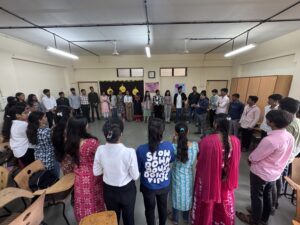
The workshop was attended by 86 students from SY and TY of various courses.