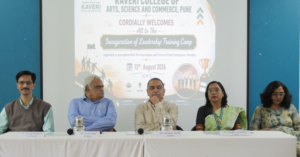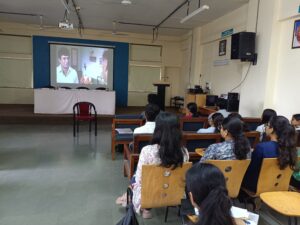
Kaveri College of Arts, Science and Commerce, Pune in association with M.R. Pai Foundation and Forum of Free Enterprise, Mumbai organized Leadership Training Camp on 12th & 13th August 2026. The workshop had an impressive lineup of two speakers, each set to deliver a unique and enriching session. The Workshop began with inaugural session, introduction and felicitation of the Resource Persons Mr. Vivek Patki and Mr. Shreepad Parkhe.
The Leadership Training Camp was organized by the Department of Arts with the objective of enhancing the overall personal and professional development of the participants. The programme focused on strengthening communication abilities through effective speaking, attentive listening, and appropriate professional behaviour. It aimed to improve decision-making and problem-solving skills through experiential activities, collaborative discussions, and practical approaches. The camp also encouraged participants to develop effective goal-setting practices based on personal values and measurable progress. Emphasis was placed on building positive habits, effective teamwork, self-confidence, empathy, meaningful relationships, and purposeful networking. Overall, the Leadership Training Camp aimed to empower participants with essential leadership qualities and skills for personal growth, professional development, and effective collaboration.
Session 1, was titled “Goal Setting & Achieving: A Roadmap to Success.” The speaker explained the importance of setting both short-term and long-term goals as a means of providing direction to personal and professional development. The SMART framework – Specific, Measurable, Achievable, Relevant, and Time-bound – was introduced as a practical approach to effective goal setting. Participants learned that dividing larger objectives into smaller and achievable milestones can make progress more manageable and consistent.
Session 1, was titled “Goal Setting & Achieving: A Roadmap to Success.” The speaker explained the importance of setting both short-term and long-term goals as a means of providing direction to personal and professional development. The SMART framework – Specific, Measurable, Achievable, Relevant, and Time-bound – was introduced as a practical approach to effective goal setting. Participants learned that dividing larger objectives into smaller and achievable milestones can make progress more manageable and consistent.
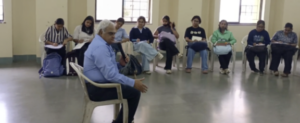
Session 2 was conducted by Mr. Vivek Patki on “Sharpening Communication Skills.” He provided an insightful overview of leadership and highlighted effective communication as one of its key foundations. He introduced the “4 P’s of Speaking” – pitch, pace, pause, and power – and explained how these elements can significantly improve public speaking.
Session 3, focused on “Decision Making and Problem-Solving Abilities.” The session commenced with an engaging activity aimed at developing participants’ problem-solving abilities. Students were encouraged to identify and note down challenges they were currently experiencing, following which the speaker explained the essence of effective problem-solving. Through collaborative group exercises, participants explored different ways of approaching and resolving challenges. The concept of “clutter” was introduced to emphasize the need to organize knowledge, resources, and tasks for greater efficiency. A decision-making activity demonstrated the importance of effective delegation, minimizing distractions, and maintaining focus.
Session 4, focused on “Mastering Habits: Unlocking Personal Potential.” He began by establishing the connection between effective goal setting and success and discussed the qualities required to achieve excellence. He emphasized that creativity must be supported by discipline and consistency. Participants were encouraged to identify their strengths, work on their weaknesses, and consciously develop constructive habits.
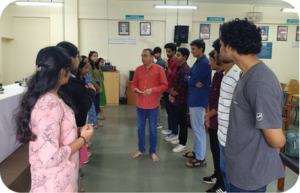
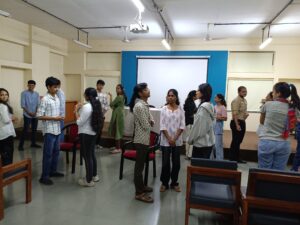
Session 5, addressed “Enhancing Essential Teamwork Skills.” The session adopted an interactive approach, with participants engaging in a group activity involving the imitation of elephants, fish, and peacocks. The activity helped students understand the significance of coordination, communication, role allocation, and cooperation within a team. It demonstrated how individuals with different roles and abilities can work together effectively to accomplish a common objective.
Session 6, facilitated by Mr. Shreepad Parkhe, focused on “Believing in Oneself: Building Meaningful Connections.” The speaker highlighted self-confidence as an essential foundation for developing meaningful personal and professional relationships. Participants were introduced to the role of body language in expressing confidence and were encouraged to move beyond their comfort zones when interacting with others.
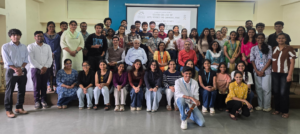
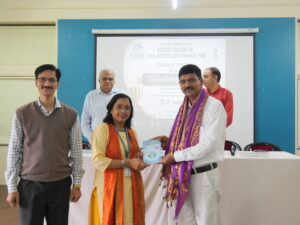
Overall, the two-day programme offered participants valuable insights into communication, problem-solving, leadership, goal setting, habit formation, teamwork, confidence, and relationship building..The workshop was attended by 57 students from SY and TY of various courses.The sessions ended with a valedictory function where Mr Krishna Devdiga the manager of Free Enterprise & M.R.Pai. Foundation was felicitated by the Principal. Various students also received participatory certificates.The sessions combined practical guidance with engaging activities, enabling students to understand these concepts and relate them to real-life academic, personal, and professional situations.