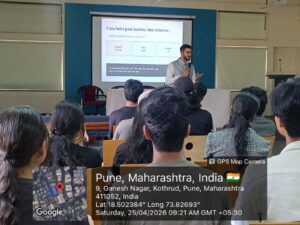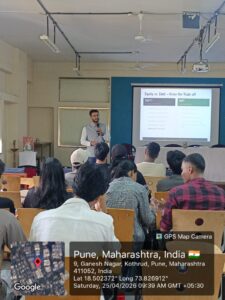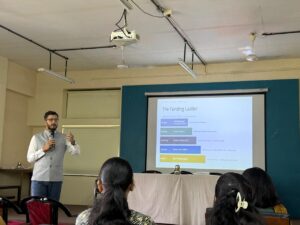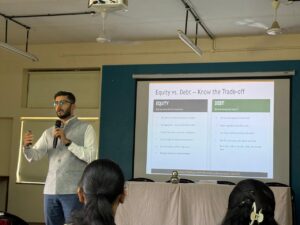

The Institution’s Innovation Council of Kaveri College of Arts, Science and Commerce successfully organized a workshop on “Raising Capital and Finance Management for Start-ups” on 25th April 2026, for students interested in entrepreneurship and business management. Workshop aimed to gain hands-on understanding of budgeting, cash flow management, and financial planning—critical for running a startup sustainably.
The session was conducted by CA. Mr. Vivaswan Damle, who shared valuable insights on startup funding and financial discipline required for entrepreneurial ventures. The workshop covered important topics such as bootstrapping, angel investment, venture capital funding, budgeting techniques, financial forecasting, break-even analysis, and cash flow management.
The resource person explained the challenges faced by start-ups in the initial stages and discussed practical methods to manage finances efficiently. Students were also introduced to different sources of raising capital and the importance of maintaining proper financial records for long-term sustainability.
The session was interactive and engaging, where students actively participated by asking questions related to startup investment, financial planning, and risk management. Real-life examples and case studies helped students understand the practical application of financial concepts in entrepreneurial ventures.
The workshop proved to be highly informative and beneficial for students aspiring to become entrepreneurs. It enhanced their understanding of startup finance and motivated them to develop innovative business ideas with proper financial planning.
The event concluded with a vote of thanks to the resource person for sharing his expertise and guiding students with practical entrepreneurial insights. Students gained knowledge about startup funding and investment opportunities. Students understood the importance of budgeting and cash flow management. Participants learned practical aspects of financial planning for start-ups. The workshop encouraged entrepreneurial thinking among students. More than 30 students participated in this workshop.